KNOWLEDGE REPOSITORY _
Useful information, hints
We created our knowledge base to provide our visitors with useful information and advice in the following areas of business life.
Many organizations treat change management as a “soft” addition to project management — something that only gets focus when the technical implementation is already on track. We, on the other hand, believe that any operational change can only be successful if change management is formally and consciously managed from the very beginning of the project. This requires a dedicated professional or team who, in close cooperation with the project team, focuses on people and the impact of change on them continuously and under all circumstances.
The relationship between project management and change management can best be compared to a double helix — an “organizational DNA”: technical implementation and human support move forward reinforcing each other, because the project only achieves its goal if the change is truly integrated into everyday operations.
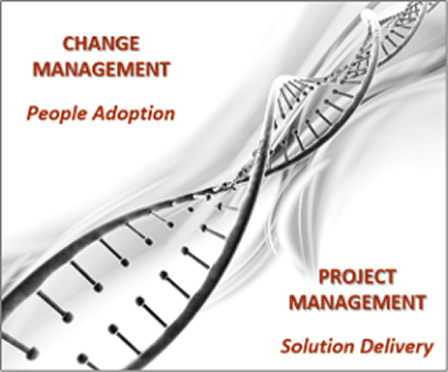
During formal change management, we apply a well-established methodology. As part of this approach, we recommend assessing the expected impacts already at the start of the project and developing a change management strategy and detailed implementation plan in alignment with the project plan. A well-designed, comprehensive and systematically executed plan significantly accelerates acceptance and ensures that the business results expected by the project are fully realized.
It is also important to mention that the change management tools (especially the change impact analysis) always support the content implementation of the project. They provide valuable input for planning, analyzing risks and dependencies, and we can often build on the information collected here even when specifying the scope of the project.
Most important tools and actions in the beginning of the project:
- Project Orientation Workshop - to clarify strategic goals and mobilize management: a guided, interactive discussion of a few hours organized at the beginning of the project during the mobilization phase with the participation of representatives of all areas affected by the project.
- Change Impact Analysis – for a detailed mapping of the effects of change: a summary analysis of the project's expected impacts, risks, dependencies and expected results based on interviews with project stakeholders.
- Change Management Plan – to summarize and track the tasks required for the change implementation: a detailed plan of the tasks required for the change, prepared based on the collected data, in line with the technical project plan, also including the communication plan.

A common feature of our most successful projects is that a designated change manager always works alongside the project manager. Their tasks include mapping the range of stakeholders, analyzing the impact of the change on them, assessing the organization's current attitude to change, and determining the steps that will increase support and reduce resistance. The "change agent / champion" network plays a key role in this - an enthusiastic internal team open to change, forming an effective communication bridge between the project management and the organization.
Many people see change management as just communication, but this is only one element of the process. A formal change management methodology is much more: in addition to the tools listed above for mapping the effects of change, it is a system of additional tools that continuously “measure the pulse” of the organization, identify hidden signals, concerns and feedback, and feed these back to project management in a timely manner. These tools have been proven to increase the success of the implementation — however, their real value lies in supporting people in understanding, accepting and implementing the change.
Additional practical tools during the project implementation:
- "Change agent / champion" network - for widespread acceptance of change: we can help the network operate successfully with various tools, from guided discussions, trainings to the use of feedback forms
- Quick feedback (Pulse) surveys – to continuously measure the “pulse” of the organization: it is recommended to involve as many channels as possible in project communication, one of the most effective tools is to regularly send out short, quick questionnaires to track the organization’s reactions to change.